


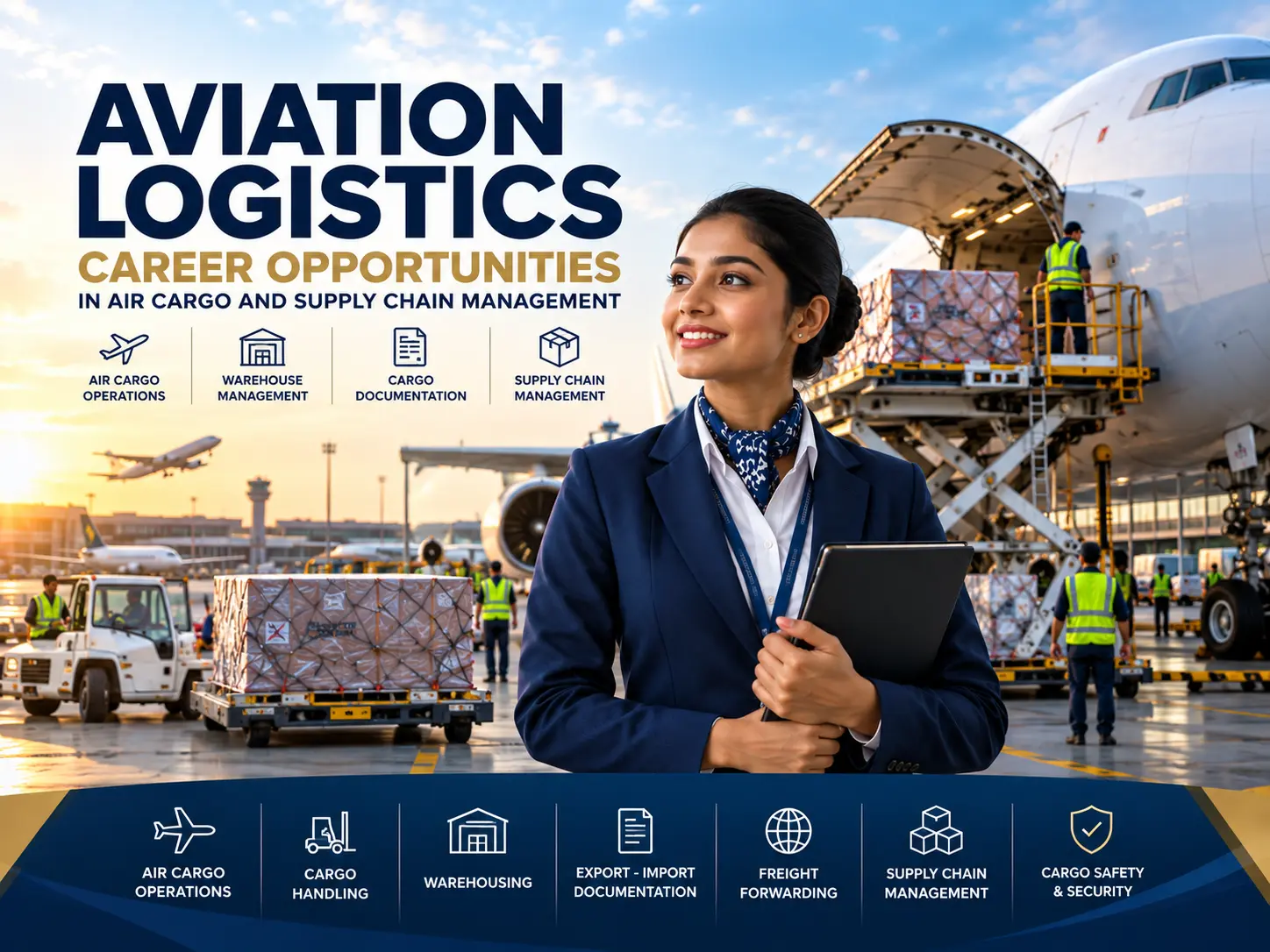
Aviation Logistics: Career Opportunities in Air Cargo and Supply Chain Management
Posted on :27/09/2026

Choosing the right career after Plus Two can be challenging, especially for students who want to enter a professional field without spending several years on a traditional degree. Logistics is one career area that offers different study pathways in supply chain management, warehousing, inventory management, export-import, shipping and related operations.
A logistics course after Plus Two can help students understand how goods move from suppliers to customers and how businesses manage transportation, warehousing, inventory and supply chain operations.
For students looking for a practical and industry-focused career path, logistics courses can provide classroom learning along with practical training and internship opportunities.
Logistics is the process of planning, managing and coordinating the movement and storage of goods from one location to another.
It includes activities such as:
Logistics plays an important role in industries such as manufacturing, retail, e-commerce, shipping, warehousing and supply chain management.
Students who have completed Plus Two can start building a career in logistics through specialised diploma and professional programmes.
A logistics course can help students develop knowledge in areas such as:
For students who prefer practical and industry-oriented learning, a logistics programme can provide exposure to real-world business operations.
The subjects covered can vary depending on the programme. However, logistics education generally focuses on important areas of supply chain and logistics operations.
Students learn how different stages of a supply chain work together, from sourcing and procurement to transportation, storage and delivery.
Understanding supply chain management helps students understand how companies plan and coordinate their operations efficiently.
Warehouse management involves organising the storage and movement of products inside a warehouse.
Students can learn about:
These skills are useful for careers in warehouses, distribution centres and supply chain companies.
International trade involves several procedures and documents.
Students interested in export-import can learn about areas such as:
This can help students understand how goods move across international markets.
Shipping and freight forwarding are important parts of logistics.
Students can gain knowledge about the movement of goods through different transportation channels and the role of freight forwarding companies in coordinating shipments.
Technology plays an important role in modern logistics operations.
Some logistics programmes include SAP training to help students understand how enterprise software can be used in areas such as inventory, procurement and supply chain operations.
Students can choose different programmes depending on their educational qualification and career goals.
Eligibility: Plus Two and above
Duration: 8 Months
Internship: 3 Months
This programme focuses on supply chain and inventory management along with SAP training.
It can be suitable for students who want to develop skills related to:
Eligibility: Plus Two and above
Duration: 4 Months
This programme focuses specifically on warehouse and inventory operations.
It can be considered by students who want to build knowledge in:
Eligibility: Degree
Duration: 1 Year
Internship: 3 Months
This programme is designed for graduates who want to develop advanced knowledge in logistics and supply chain management along with SAP.
Eligibility: Degree
Duration: 8 Months
Internship: 3 Months
This programme focuses on supply chain operations and export-import management.
It can be relevant for students interested in:
Before selecting a logistics programme, students should consider several factors.
If you have completed Plus Two, look for programmes that specifically accept Plus Two students.
Some advanced logistics programmes require a degree, so always check the eligibility requirements before applying.
Logistics is an operational field. Practical exposure can help students understand how logistics processes work beyond classroom theory.
Look for institutes that provide:
Internships can help students gain exposure to actual workplace environments.
A structured internship can allow students to understand logistics operations and develop practical workplace skills.
Additional certifications and training can help students develop specialised knowledge.
Depending on the programme, this may include training in areas such as SAP, supply chain operations, warehouse management and export-import procedures.
Logistics professionals regularly communicate with customers, suppliers, transporters, warehouse teams and other departments.
Good communication and documentation skills can therefore be useful for building a career in logistics.
Logistics is not only about understanding concepts. Students also need to understand how those concepts are applied in actual business operations.
Practical training can help students understand:
An industry-integrated learning environment can give students greater exposure to practical aspects of the logistics sector.
Internships are an important part of many logistics programmes.
For example, selected programmes at URBX Logistics Academy include a 3-month internship.
Internship exposure can help students:
Students should check the exact internship structure and eligibility before enrolling in a programme.
A logistics qualification can open career pathways across different areas of the logistics and supply chain industry.
Depending on their qualification and skills, students can explore roles such as:
Career opportunities can vary depending on the student’s qualification, practical experience, skills and employer requirements.
Logistics professionals can work across several industries, including:
Shipping and freight forwarding companies require professionals to coordinate shipments, documentation and logistics activities.
Warehouses and distribution centres require employees for inventory management, storage and movement of goods.
The growth of online shopping has increased the importance of warehousing, transportation and last-mile delivery operations.
Manufacturing companies depend on logistics and supply chain operations for sourcing materials, inventory management and distribution.
Supply chain organisations require professionals who can coordinate different stages of procurement, storage, transportation and distribution.
Kochi is an important location for students interested in logistics education because students can pursue logistics programmes while being connected to a city with established commercial and transportation activities.
For students from Kerala, studying a logistics course in Kochi can also provide access to industry-oriented training programmes and internship opportunities.
When choosing a logistics institute in Kochi, students should compare:
An industry-integrated learning approach combines academic learning with practical exposure.
At URBX Logistics Academy, the programmes focus on areas such as supply chain management, warehousing, transportation, export-import and logistics operations.
The academy also highlights practical learning, experienced faculty, industry exposure, internships and career support.
Choosing a course is only one part of starting a logistics career. Students also need support in preparing for employment.
Career support can include:
URBX Logistics Academy provides placement assistance and career support as part of its student-focused approach.
Students should understand that placement assistance is different from a guaranteed job, and actual employment depends on factors such as qualification, skills, performance, vacancies and employer requirements.
| Course | Eligibility | Duration | Internship |
| Advanced Diploma in Supply Chain and Inventory Management + SAP | Plus Two & Above | 8 Months | 3 Months |
| Professional Programme in Warehouse and Inventory Management | Plus Two & Above | 4 Months | Check programme details |
| PG Diploma in Logistics and Supply Chain Management + SAP | Degree | 1 Year | 3 Months |
| Advanced Diploma in Supply Chain and Export-Import Management | Degree | 8 Months | 3 Months |
Logistics can be a suitable career option for students who are interested in supply chain operations, transportation, warehousing, inventory management and international trade.
It can be especially relevant for students who prefer practical and industry-oriented careers.
Before choosing a programme, students should consider their interests and compare the curriculum, practical training, internship opportunities and career support offered by different institutes.
Students can follow a simple pathway:
Most entry-level logistics programmes accept students who have completed Plus Two.
Choose an area based on your interest, such as:
Compare course duration, eligibility, curriculum, practical training and internship opportunities before choosing an institute.
Use internships and practical training to understand real logistics operations.
Improve communication, documentation, computer skills, analytical thinking and problem-solving abilities.
After completing the course and gaining practical exposure, students can explore entry-level opportunities in logistics, warehousing, shipping, supply chain and related industries.
URBX Logistics Academy in Kochi focuses on industry-oriented logistics education with practical learning.
The academy offers programmes covering areas such as:
The academy also provides practical training, internship opportunities, experienced faculty and placement assistance.
For students looking for a logistics course after Plus Two, the Advanced Diploma in Supply Chain and Inventory Management + SAP and the Professional Programme in Warehouse and Inventory Management are options to explore based on their career interests.
A logistics course after Plus Two can provide students with a structured pathway into the logistics and supply chain industry.
From warehouse and inventory management to supply chain operations, export-import and SAP, students can choose programmes based on their interests and career goals.
When selecting a logistics institute, focus on practical training, internship opportunities, industry exposure, curriculum, faculty experience and career support rather than choosing a course based only on its name.
For students looking for industry-oriented logistics education in Kochi, URBX Logistics Academy offers programmes for both Plus Two students and graduates.
Students who have completed Plus Two can explore programmes such as Advanced Diploma in Supply Chain and Inventory Management + SAP and Professional Programme in Warehouse and Inventory Management.
Many entry-level logistics programmes accept students who have completed Plus Two. Advanced programmes may require a degree.
Course duration depends on the programme. At URBX Logistics Academy, programmes range from 4 months to 1 year, with selected programmes including a 3-month internship.
SAP training can help students understand technology-based business processes used in areas such as supply chain, inventory and procurement.
Selected logistics programmes include internship opportunities. At URBX Logistics Academy, several programmes include a 3-month internship.
Depending on your qualification and skills, you can explore roles such as Logistics Executive, Warehouse Executive, Inventory Executive, Supply Chain Executive, Export-Import Executive and Documentation Executive.
Yes. Selected logistics programmes are available for students who have completed Plus Two.
Students can explore industry-oriented logistics programmes at URBX Logistics Academy in Kochi.
Best Logistics Institute in Kochi
https://urbxlogisticsacademy.com/best-logistics-training-institute-in-kochi-kerala/
Explore Logistics Courses in Kochi
https://urbxlogisticsacademy.com/